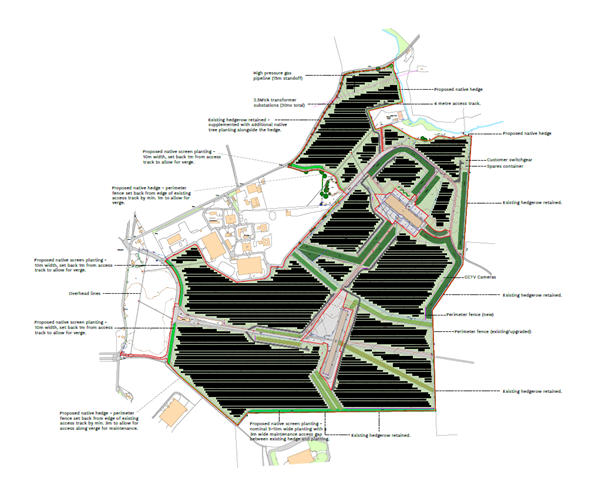
Berrys provided civil engineering support to accompany a planning application for a proposed c49.9 megawatt solar farm and associated infrastructure on the site of a former airfield at High Ercall in Shropshire.
Our engineering team provided transport planning, highways and flood risk consultancy services. A Transport Statement, Construction Traffic Management Plan (CTMP) and Flood Risk Assessment (FRA) were prepared to accompany the planning submission, which was led by Berrys’ in house planning specialists.
Following the granting of planning permission, we also assisted with the discharge of pre-commencement conditions to provide a Site Environmental Management Plan (SEMP), Detailed Traffic Marshalling Scheme and Detailed Drainage Strategy.
Transport Statement including CTMP
The application site is located in a rural setting, with considerable constraints on the adjoining highway network. From a transportation perspective, the main impacts from the proposed development arise during the construction and decommissioning phases, which needed to be assessed within the adjoining highway context. A Transport Statement was prepared to discuss and assess the following:
- Local highway context.
- Development access including access visibility and swept path assessments.
- Vehicle routing including assessment of available passing opportunities.
- Anticipated quantum of construction traffic movements.
The site bordered a large car distribution depot which generates daily car transporter movements, this required consideration as to how potential conflicts would be managed along the rural access route. Our team worked collaboratively with the developer to plan the working practices, methods and actions to be taken by the Principal Contractor during the construction and decommissioning development phases. This resulted in a package of measures which were accepted by the local highway authority.
Flood Risk Assessment
A Flood Risk Assessment (FRA) was essential to evaluate the potential risks and impacts of flooding on the site, and to neighbouring property. In accordance with the National Planning Policy Framework (NPPF) an FRA is also key to ensure the resilience of the infrastructure for its whole lifecycle. The FRA reviewed flood hazards from various sources, including fluvial (rivers), surface water, sewers, reservoirs, ground water, and assessed the vulnerability of solar panels, inverters, access roads, and other key components. By analysing desktop data, local topography, and Environment Agency flood data, the FRA determined the flood risk for different scenarios, such as a 1% annual event probability design flood event. It also provided recommendations for mitigation measures.
During the assessment, a small number of inverters and switch gear were found to be placed in surface water flood risk areas. Where these could not be relocated, recommendations were made to elevate the equipment above the water level, ultimately reducing the risk of the infrastructure failing due to climate factors. The FRA supported the planning application, demonstrating that the development complied with local planning policies and the NPPF guidelines for sustainable and climate-resilient infrastructure.
Detailed Drainage Strategy
During the planning process, we found that a private surface water drain passed over the expansive former airfield site and that this was critical for managing local flood risk. To manage the risk associated with the drain Berrys organised a drainage survey, which mapped the lines of sewers across the site. We were then able to work with the client and to work up solutions for the PV mounting frames, which reduced the risk of damaging existing sewers.
Berrys also organised the BRE 365 infiltration tests, which were required to inform the detailed SuDS for the site. As the tests revealed low permeability, we designed alternative drainage discharge locations to the existing surface water drains. Formal drainage was provided for the new impermeable site roads and invertor / switch gear units. Proposals were developed in accordance with CIRIA C753 which in the main used filter drains as attenuation storage, with vortex flow control devices to restrict run-off to greenfield rates. Overall, the drainage strategy deliverables included hydraulic modelling, design drawings and technical reports, which were submitted for planning discharge of conditions.
Site Environmental Management Plan
A SEMP was prepared to provide information and details of the working practises to be followed by the developer when carrying out the construction works, to minimise the environmental impact of the works. The SEMP addressed the following:
• Location of site compound
• Parking of vehicles of site personnel, operatives and visitors
• Loading and unloading of plant and materials
• Storage of plant and materials
• Storage of oil, fuel and chemicals
• Protection of ecology and archaeology
• Measures to prevent mud being deposited on the highway, control and reduction of noise and dust from construction works
Traffic Marshalling Scheme
Following on from measures outlined within the CTMP, a detailed traffic marshalling scheme was prepared to assist in the co-ordination of heavy traffic movements along the rural road network during the construction phase.
In order to reduce the potential for construction traffic to meet along the lane, a shuttle scheme was devised for site HGV traffic. This would ensure that the impact of the works was managed to an acceptable level for the local community. The details were found to be acceptable by the Local Highway Authority, which allowed the discharge of the corresponding pre-commencement planning condition.


 Architecture
 Online Auctions
 Building Surveying
 Business, Land Use & Finance
 Charity Property Advisory
 Development Management
 Energy & Sustainability
 Engineering & Land Surveying
 Heritage & Archaeology
 Planning
 Property Agency
 Property Litigation Support
 Property Management
 Rural Landlord & Tenant
 Strategic Land
 Valuation